💰 Free Payroll Calculator — 2026 Tax Year
Calculate your take-home pay with federal & state taxes
How to Use the Payroll Calculator
Our free payroll calculator helps you quickly estimate your take-home pay after federal and state tax withholdings. Here's how to get the most accurate results:
- Enter your gross pay — This is your total pay before any taxes or deductions. Enter the amount per pay period (not your annual salary, unless you select “Annually” as your pay frequency).
- Select your pay frequency — Choose how often you get paid: weekly (52), bi-weekly (26), semi-monthly (24), monthly (12), or annually (1).
- Choose your filing status — Single or Married Filing Jointly affects your federal tax brackets and standard deduction.
- Pick your state — We calculate state-specific income tax using 2026 tax brackets for all 50 states.
- Add pre-tax deductions (optional) — Include 401(k) contributions and health insurance premiums to see their impact on your take-home pay.

What Gets Deducted From Your Paycheck?
Every paycheck includes mandatory deductions that fund federal programs and state services. Understanding these deductions helps you plan your budget effectively.
Federal Income Tax Source: IRS.gov
Federal income tax uses a progressive bracket system. For 2026, the rates range from 10% to 37% based on your taxable income and filing status. The standard deduction is $16,100 for single filers and $32,200 for married filing jointly. See our complete 2026 federal tax bracket guide for detailed tables.
Social Security Tax (OASDI) Source: SSA.gov
Both employees and employers pay 6.2% of wages toward Social Security, up to the wage base of $184,500 in 2026. This tax funds retirement, disability, and survivor benefits through the Old-Age, Survivors, and Disability Insurance (OASDI) program.
Medicare Tax Source: IRS.gov
Medicare tax is 1.45% of all wages (no cap). An additional 0.9% applies to earnings above $200,000 for individuals. Combined with Social Security, these two taxes make up your FICA contribution (7.65%). Learn more in our payroll tax calculation guide.

State Income Tax
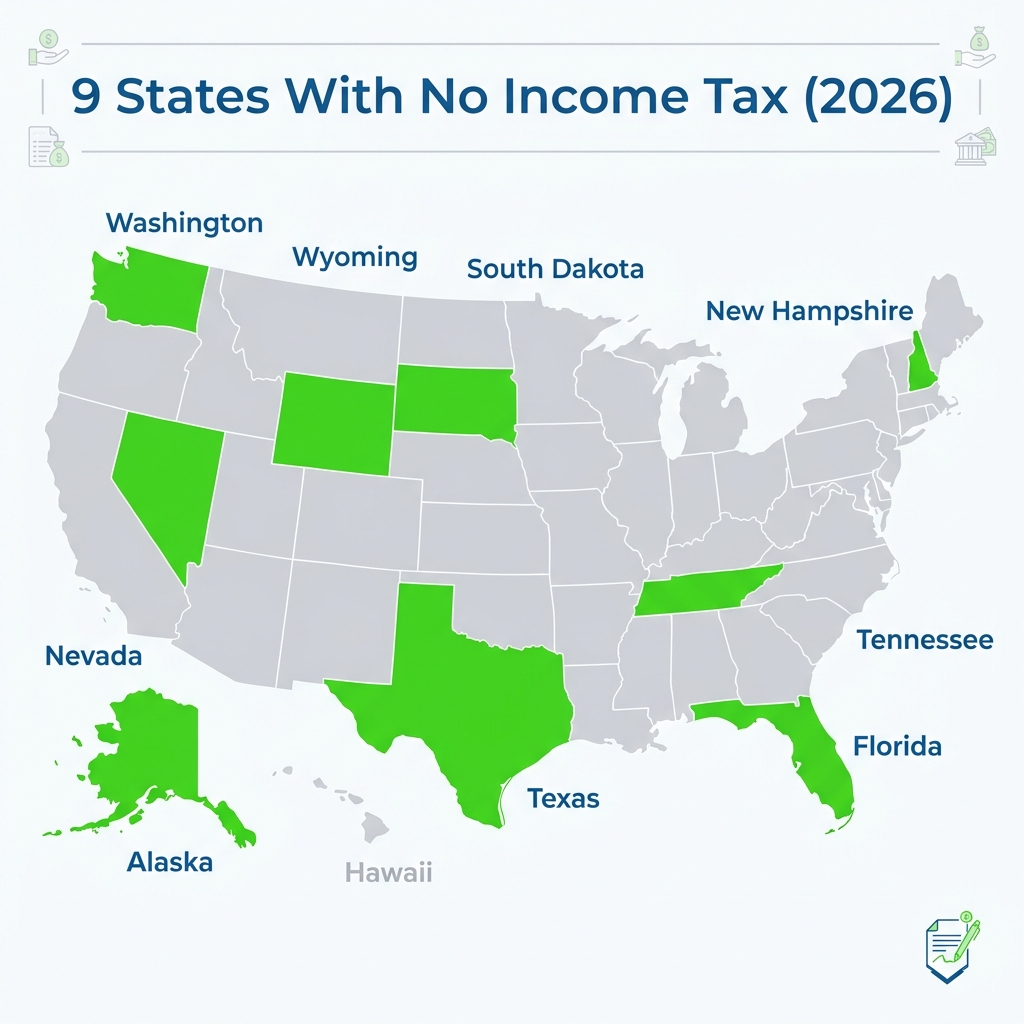
State income taxes vary widely. Nine states have no income tax at all: Alaska, Florida, Nevada, New Hampshire, South Dakota, Tennessee, Texas, Washington, and Wyoming. Others range from flat rates (like Colorado's 4.4%) to progressive systems (like California's 1-13.3%). See all 50 state tax calculators.
Pro Tip: If you're comparing job offers across states, use our state-specific calculators to see the real difference in take-home pay. A $75,000 salary in Texas (no state tax) puts significantly more money in your pocket than the same salary in California (up to 13.3% state tax).
Payroll Calculator by State
Select your state to use a payroll calculator with pre-configured state tax rates and rules for 2026.
Popular Hourly to Salary Conversions
Quickly see what your hourly wage equals as an annual salary, or convert a salary to an hourly rate.
Frequently Asked Questions
Understanding Your Payroll in 2026
Payroll calculation involves multiple layers of taxes and deductions that can be confusing for both employees and employers. Whether you're starting a new job, negotiating a salary, or running a small business, understanding how payroll works is essential for financial planning.
For Employees
As an employee, your paycheck is reduced by federal income tax, state income tax (in most states), Social Security tax (6.2%), and Medicare tax (1.45%). The total federal payroll tax rate for employees is 7.65% for FICA alone, before any income tax withholding. Use our salary-to-hourly converter to estimate your hourly rate from an annual salary, or browse our hourly-to-salary conversions if you're paid by the hour.
For Employers
Employers match the employee's 7.65% FICA contribution and also pay Federal Unemployment Tax (FUTA) of 0.6% on the first $7,000 of each employee's wages. State unemployment insurance (SUI) rates vary by state and employer history. Use our employer cost calculator to see the true total cost of hiring.
For Freelancers & Self-Employed
If you're self-employed, you pay both the employee and employer portions of FICA, totaling 15.3%. Use our self-employment tax calculator to estimate your SE tax, quarterly payments, and the 50% deduction. Read the IRS self-employment tax guide for official rules.
Payroll Calculator for Small Business
Small business owners face unique payroll challenges, especially when calculating taxes for their first employees. Our employer cost calculator helps estimate the true cost of hiring, while our state-specific calculators handle the complex rules in states like California, New York, and New Jersey where local taxes add extra complexity.
More Payroll Tools
Beyond the main calculator, we offer specialized tools for specific payroll scenarios: