Bonus Tax Calculator — How Are Bonuses Taxed? (2026)

See exactly how much tax you'll pay on your bonus. Bonuses are classified as "supplemental wages" by the IRS and are typically withheld at a flat 22% federal rate — higher than many people expect.
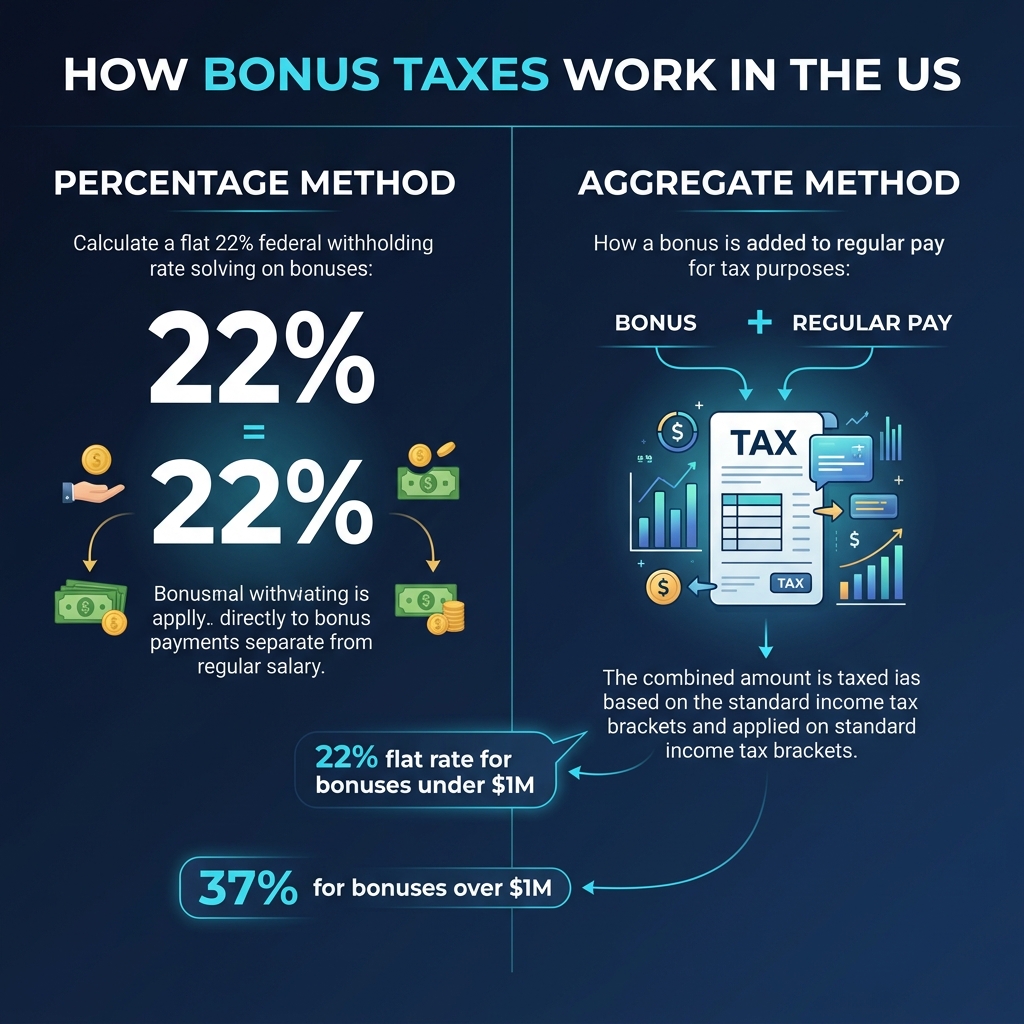
Infographic: How bonus taxes work in the US — Percentage Method (22% flat rate) vs Aggregate Method

💰 Bonus Tax Breakdown (Percentage Method)

The most common method employers use. Your bonus is taxed separately from regular pay at a flat 22% federal withholding rate, plus FICA:

Bonus AmountFederal (22%)Social Security (6.2%)Medicare (1.45%)Total TaxAfter-Tax Bonus
$1,000.00$220.00$62.00$14.50$296.50$703.50
$2,500.00$550.00$155.00$36.25$741.25$1,758.75
$5,000.00$1,100.00$310.00$72.50$1,482.50$3,517.50
$7,500.00$1,650.00$465.00$108.75$2,223.75$5,276.25
$10,000.00$2,200.00$620.00$145.00$2,965.00$7,035.00
$15,000.00$3,300.00$930.00$217.50$4,447.50$10,552.50
$20,000.00$4,400.00$1,240.00$290.00$5,930.00$14,070.00
$25,000.00$5,500.00$1,550.00$362.50$7,412.50$17,587.50
$50,000.00$11,000.00$3,100.00$725.00$14,825.00$35,175.00
$100,000.00$22,000.00$6,200.00$1,450.00$29,650.00$70,350.00
Note: State taxes (0-13.3%) are additional. The table above shows federal + FICA only. Effective withholding rate is approximately 29.65% before state taxes.

📋 Two Methods for Taxing Bonuses Source: IRS Pub 15

Method 1: Percentage Method (Most Common)

Your employer withholds a flat 22% from the bonus for federal income tax. This is the simpler method and is used by most employers.

  • Bonuses under $1 million: 22% flat rate
  • Bonuses over $1 million: 22% on first $1M + 37% on excess

Method 2: Aggregate Method

Your employer adds the bonus to your regular paycheck and calculates total withholding as if the combined amount is your normal pay. This often results in higher withholding because the bonus temporarily pushes you into a higher tax bracket.

Why does my bonus seem so heavily taxed? If your employer uses the aggregate method, your bonus gets taxed as if you earn that inflated amount every paycheck. The extra withholding is refunded when you file your tax return, if your actual bracket is lower.

Important: Withholding ≠ Tax

The 22% flat rate is a withholding rate, not a tax rate. Bonuses are taxed as ordinary income at your marginal tax rate when you file. If you're in the 12% bracket, you may get a refund. If you're in the 32%+ bracket, you may owe more.

🧮 Bonus Impact by Tax Bracket

Here's how a $10,000 bonus is actually taxed at filing time (vs. withholding):

Tax BracketWithheld (22%)Actual TaxRefund/(Owed)
10%$2,200.00$1,000.00+$1,200.00 refund
12%$2,200.00$1,200.00+$1,000.00 refund
22%$2,200.00$2,200.00Even
24%$2,200.00$2,400.00-$200.00 owed
32%$2,200.00$3,200.00-$1,000.00 owed
37%$2,200.00$3,700.00-$1,500.00 owed

💡 How to Keep More of Your Bonus

  • Increase 401(k) contributions: Ask your employer to route part of your bonus to your 401(k) — this reduces the taxable amount
  • Contribute to HSA: If eligible, pre-tax HSA contributions reduce your taxable bonus income
  • Adjust W-4 allowances: If you expect a large bonus, temporarily increase withholding on regular paychecks to avoid owing at tax time
  • Time your bonus: If possible, receiving your bonus in January vs December could shift it to a lower-income tax year

Bonus Tax FAQ

🔗 Related Tools

Mustafa Bilgic
Operator disclosure

Mustafa Bilgic

Individual site operator; not a CPA, EA, or tax preparer

PayrollCalculator.us is operated by Mustafa Bilgic as an informational calculator site. Mustafa Bilgic is not a CPA, enrolled agent, or tax preparer; estimates should be checked against IRS and state revenue guidance and reviewed by a qualified professional.

Bonus tax calculator: 2026 Calculation Guide

This calculator is designed to make the payroll math behind supplemental wages, percentage withholding, aggregate withholding, and bonus cash planning easier to inspect. A useful payroll estimate should show the difference between gross wages, taxable wages, employee deductions, employer taxes, and final take-home pay. It should also make clear which numbers are federal, which numbers are state-specific, and which items depend on the worker's own Form W-4 or state withholding certificate.

For 2026, the federal payroll foundation is Social Security at 6.2 percent up to the $184,500 wage base, Medicare at 1.45 percent with no regular wage cap, and Additional Medicare withholding at 0.9 percent above the federal payroll threshold. Employers also match regular Social Security and Medicare, while FUTA is employer-paid on the first $7,000 of wages when applicable. These items should not be mixed with employee federal income tax withholding.

Worked example: suppose gross wages are $3,000 for a biweekly check. Employee Social Security is $186.00 while the worker is below the annual wage base. Employee Medicare is $43.50. Federal income tax withholding depends on Form W-4, pay frequency, taxable wages after eligible pre-tax deductions, and IRS withholding methods. State withholding then depends on the work state, residence state, local rules, and any state certificate on file.

Pre-tax deductions can change the estimate in different ways. Traditional 401(k) contributions usually reduce federal income tax wages but do not reduce Social Security or Medicare wages. Section 125 health premiums can reduce federal income tax wages and often FICA wages. Roth retirement contributions are usually after-tax. A calculator should let the user separate those assumptions instead of treating every deduction the same way.

IRS form references matter because each calculator output eventually ties to a filing system. Form W-4 drives employee federal withholding elections. Form 941 reports quarterly federal income tax withholding plus employee and employer FICA. Form 940 reports FUTA. Forms W-2 and W-3 report annual wages. Self-employed workers may use Schedule SE. Household employers may use Schedule H. The exact form depends on the payroll situation.

State payroll can change the result materially. Use the state payroll index for jurisdiction-specific pages such as California payroll, New York payroll, Texas payroll, and District of Columbia payroll. Those pages include state income tax bracket summaries, FICA notes, withholding workflow, and official revenue agency source links.

Employers should use calculator results as planning estimates, not as deposit instructions. A payroll run still needs a legal employer account, current state registration, assigned deposit frequency, state unemployment rate notice, payroll records, and confirmation that deposits were made under the correct EIN and tax period. Late deposits can trigger penalties even when the paycheck estimate itself is mathematically correct.

Employees should use the result to understand cash flow. If take-home pay is lower than expected, review gross wages, pay frequency, pre-tax benefits, filing status, state selection, local tax assumptions, and year-to-date wages. If withholding is too high or too low over multiple paychecks, the practical correction is often a revised Form W-4 or state withholding certificate rather than a different calculator.

For deeper source-backed detail, use 2026 federal payroll tax rates, payroll deadline calendar, penalty guide, and state payroll comparison. Those reference pages connect this calculator to IRS Pub. 15, federal payroll deadlines, state tax agency links, and worker classification rules. They also carry the same non-CPA disclaimer used across PayrollCalculator.us so estimates are not mistaken for professional tax advice.

Recordkeeping is part of payroll accuracy. Save the gross wage input, pay date, pay period, state, filing assumptions, pre-tax deductions, and calculator output when using an estimate to make a business or household budget decision. If a real payroll run later differs, the saved assumptions make it easier to see whether the difference came from taxes, benefits, local rules, prior wages, or payroll provider settings.

Review itemWhy it matters
Gross wagesStarting point for income tax and FICA calculations.
Pay frequencyChanges annualization and withholding method assumptions.
State pageCaptures state brackets, no-tax treatment, or local caveats.
IRS form referenceConnects the estimate to W-4, 941, 940, W-2/W-3, Schedule SE, or Schedule H as applicable.
DisclaimerConfirms the result is informational and not tax advice.
Disclaimer: NOT tax advice. Mustafa Bilgic is not a CPA, EA, or tax preparer. Consult a qualified tax professional before relying on these estimates.