Small Business Payroll Calculator — Budget Payroll Taxes (2026)

Calculate payroll tax costs for your small business. See exactly how much you'll pay in employer taxes (FICA, FUTA, SUI) per employee and budget your total payroll expenses accurately.
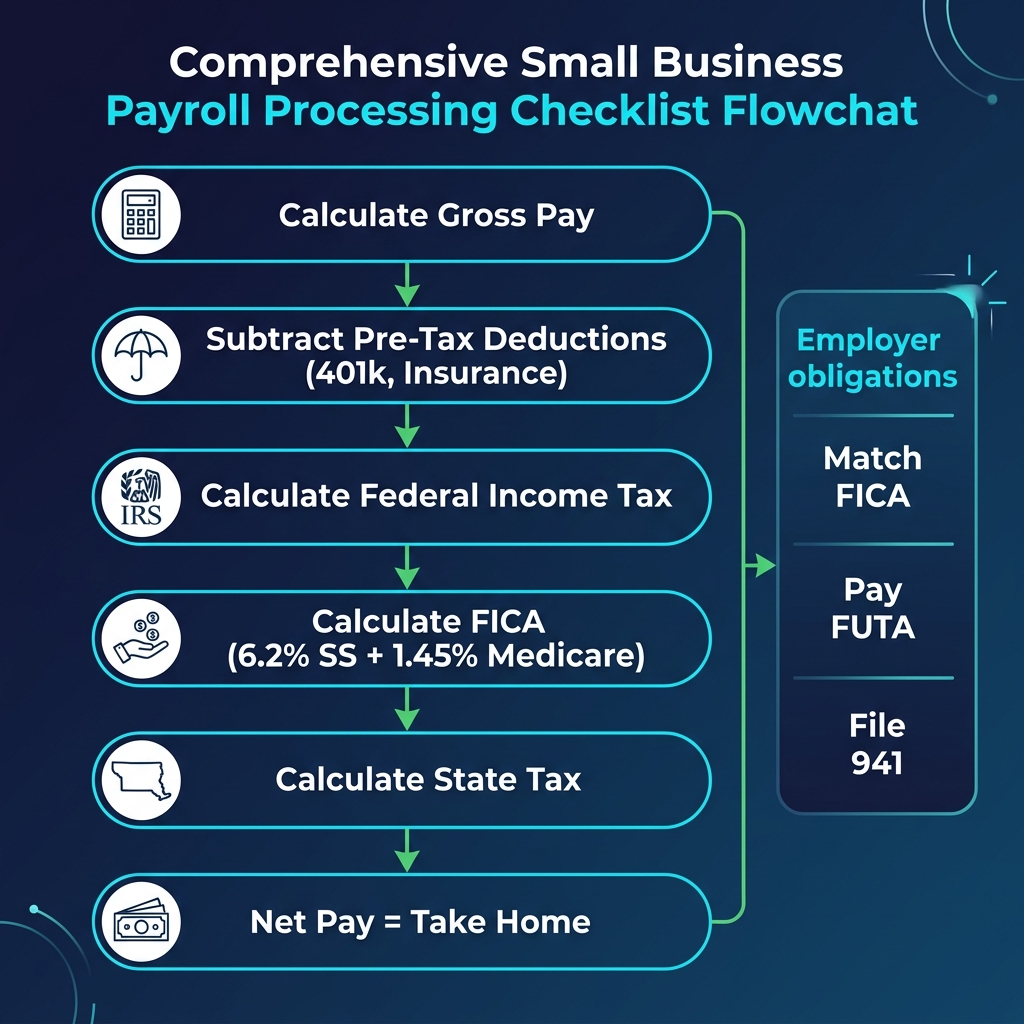
Infographic: Small business payroll processing checklist flowchart showing steps from gross pay calculation through FICA, federal and state taxes to net pay, with employer obligations sidebar

🏢 Employer Payroll Tax Rates for 2026

TaxRateWage BaseNotes
Social Security (OASDI)6.2%$184,500Employer match
Medicare (HI)1.45%No capEmployer match
FUTA0.6%$7,000After state credit
State Unemployment (SUI)0.5–8.5%VariesBased on experience rating
Total Employer FICA7.65%SS + Medicare combined

📊 Employer Tax Cost Per Employee

Here's the minimum employer payroll tax cost (before SUI) at different salary levels:

Employee SalaryEmployer SSEmployer MedicareFUTATotal Employer Tax% of Salary
$30,000.00$1,860.00$435.00$42.00$2,337.007.79%
$40,000.00$2,480.00$580.00$42.00$3,102.007.75%
$50,000.00$3,100.00$725.00$42.00$3,867.007.73%
$60,000.00$3,720.00$870.00$42.00$4,632.007.72%
$75,000.00$4,650.00$1,087.50$42.00$5,779.507.71%
$85,000.00$5,270.00$1,232.50$42.00$6,544.507.7%
$100,000.00$6,200.00$1,450.00$42.00$7,692.007.69%
$120,000.00$7,440.00$1,740.00$42.00$9,222.007.69%

👥 Total Payroll Budget by Team Size

Estimate your annual payroll budget based on team size (average salary: $55,000, avg SUI rate: 2.7%):

Team SizeTotal SalariesEmployer FICA+FUTAEst. SUITotal Annual Cost
1 employee$55,000.00$4,249.50$1,485.00$60,734.50
3 employees$165,000.00$12,748.50$4,455.00$182,203.50
5 employees$275,000.00$21,247.50$7,425.00$303,672.50
10 employees$550,000.00$42,495.00$14,850.00$607,345.00
15 employees$825,000.00$63,742.50$22,275.00$911,017.50
25 employees$1,375,000.00$106,237.50$37,125.00$1,518,362.50
50 employees$2,750,000.00$212,475.00$74,250.00$3,036,725.00

📋 Small Business Payroll Checklist

Getting Started

  • ✅ Get an EIN (apply online)
  • ✅ Register with your state for unemployment insurance (SUI)
  • ✅ Have employees complete W-4 (federal) and state withholding forms
  • ✅ Verify employment eligibility (Form I-9)
  • ✅ Set up a payroll schedule (weekly, bi-weekly, semi-monthly, or monthly)

Each Pay Period

  • Calculate gross pay (salary ÷ pay periods, or hours × rate)
  • Subtract pre-tax deductions (401k, health insurance)
  • Calculate and withhold federal income tax (2026 brackets)
  • Calculate and withhold state income tax (state calculators)
  • Withhold employee FICA (6.2% SS + 1.45% Medicare)
  • Set aside employer FICA match (another 7.65%)

Tax Deposits Source: IRS.gov

  • Monthly depositors: Deposit by the 15th of the following month
  • Semi-weekly depositors: Deposit within 3 business days of payday
  • FUTA: Deposit quarterly if liability exceeds $500

Annual Filings

  • Form 941 — Quarterly federal tax return
  • Form 940 — Annual FUTA tax return
  • W-2s — To employees by January 31
  • W-3 — To SSA by January 31
  • State filings — Vary by state

💡 Tips to Reduce Payroll Costs

  • Hire in no-income-tax states — Remote workers in Texas, Florida, or Washington save employees on state tax (though employer SUI still applies)
  • Maximize Section 125 plans — Pre-tax health insurance reduces FICA for both you and employees
  • Consider S-Corp structure — S-Corp owners can pay reasonable salary + distributions to minimize SE tax
  • Use the Work Opportunity Tax Credit (WOTC) — Up to $9,600 credit per qualifying new hire
  • Claim FICA Tip Credit — Restaurant owners can credit employer FICA on tips above minimum wage

Small Business Payroll FAQ

🔗 Related Tools

Mustafa Bilgic
Operator disclosure

Mustafa Bilgic

Individual site operator; not a CPA, EA, or tax preparer

PayrollCalculator.us is operated by Mustafa Bilgic as an informational calculator site. Mustafa Bilgic is not a CPA, enrolled agent, or tax preparer; estimates should be checked against IRS and state revenue guidance and reviewed by a qualified professional.

Small business payroll calculator: 2026 Calculation Guide

This calculator is designed to make the payroll math behind team payroll budgets, employer taxes, state accounts, and quarterly returns easier to inspect. A useful payroll estimate should show the difference between gross wages, taxable wages, employee deductions, employer taxes, and final take-home pay. It should also make clear which numbers are federal, which numbers are state-specific, and which items depend on the worker's own Form W-4 or state withholding certificate.

For 2026, the federal payroll foundation is Social Security at 6.2 percent up to the $184,500 wage base, Medicare at 1.45 percent with no regular wage cap, and Additional Medicare withholding at 0.9 percent above the federal payroll threshold. Employers also match regular Social Security and Medicare, while FUTA is employer-paid on the first $7,000 of wages when applicable. These items should not be mixed with employee federal income tax withholding.

Worked example: suppose gross wages are $3,000 for a biweekly check. Employee Social Security is $186.00 while the worker is below the annual wage base. Employee Medicare is $43.50. Federal income tax withholding depends on Form W-4, pay frequency, taxable wages after eligible pre-tax deductions, and IRS withholding methods. State withholding then depends on the work state, residence state, local rules, and any state certificate on file.

Pre-tax deductions can change the estimate in different ways. Traditional 401(k) contributions usually reduce federal income tax wages but do not reduce Social Security or Medicare wages. Section 125 health premiums can reduce federal income tax wages and often FICA wages. Roth retirement contributions are usually after-tax. A calculator should let the user separate those assumptions instead of treating every deduction the same way.

IRS form references matter because each calculator output eventually ties to a filing system. Form W-4 drives employee federal withholding elections. Form 941 reports quarterly federal income tax withholding plus employee and employer FICA. Form 940 reports FUTA. Forms W-2 and W-3 report annual wages. Self-employed workers may use Schedule SE. Household employers may use Schedule H. The exact form depends on the payroll situation.

State payroll can change the result materially. Use the state payroll index for jurisdiction-specific pages such as California payroll, New York payroll, Texas payroll, and District of Columbia payroll. Those pages include state income tax bracket summaries, FICA notes, withholding workflow, and official revenue agency source links.

Employers should use calculator results as planning estimates, not as deposit instructions. A payroll run still needs a legal employer account, current state registration, assigned deposit frequency, state unemployment rate notice, payroll records, and confirmation that deposits were made under the correct EIN and tax period. Late deposits can trigger penalties even when the paycheck estimate itself is mathematically correct.

Employees should use the result to understand cash flow. If take-home pay is lower than expected, review gross wages, pay frequency, pre-tax benefits, filing status, state selection, local tax assumptions, and year-to-date wages. If withholding is too high or too low over multiple paychecks, the practical correction is often a revised Form W-4 or state withholding certificate rather than a different calculator.

For deeper source-backed detail, use 2026 federal payroll tax rates, payroll deadline calendar, penalty guide, and state payroll comparison. Those reference pages connect this calculator to IRS Pub. 15, federal payroll deadlines, state tax agency links, and worker classification rules. They also carry the same non-CPA disclaimer used across PayrollCalculator.us so estimates are not mistaken for professional tax advice.

Recordkeeping is part of payroll accuracy. Save the gross wage input, pay date, pay period, state, filing assumptions, pre-tax deductions, and calculator output when using an estimate to make a business or household budget decision. If a real payroll run later differs, the saved assumptions make it easier to see whether the difference came from taxes, benefits, local rules, prior wages, or payroll provider settings.

Review itemWhy it matters
Gross wagesStarting point for income tax and FICA calculations.
Pay frequencyChanges annualization and withholding method assumptions.
State pageCaptures state brackets, no-tax treatment, or local caveats.
IRS form referenceConnects the estimate to W-4, 941, 940, W-2/W-3, Schedule SE, or Schedule H as applicable.
DisclaimerConfirms the result is informational and not tax advice.
Disclaimer: NOT tax advice. Mustafa Bilgic is not a CPA, EA, or tax preparer. Consult a qualified tax professional before relying on these estimates.